Seven Lakes High School

Orchestras

News

News

UIL PREVIEW CONCERT

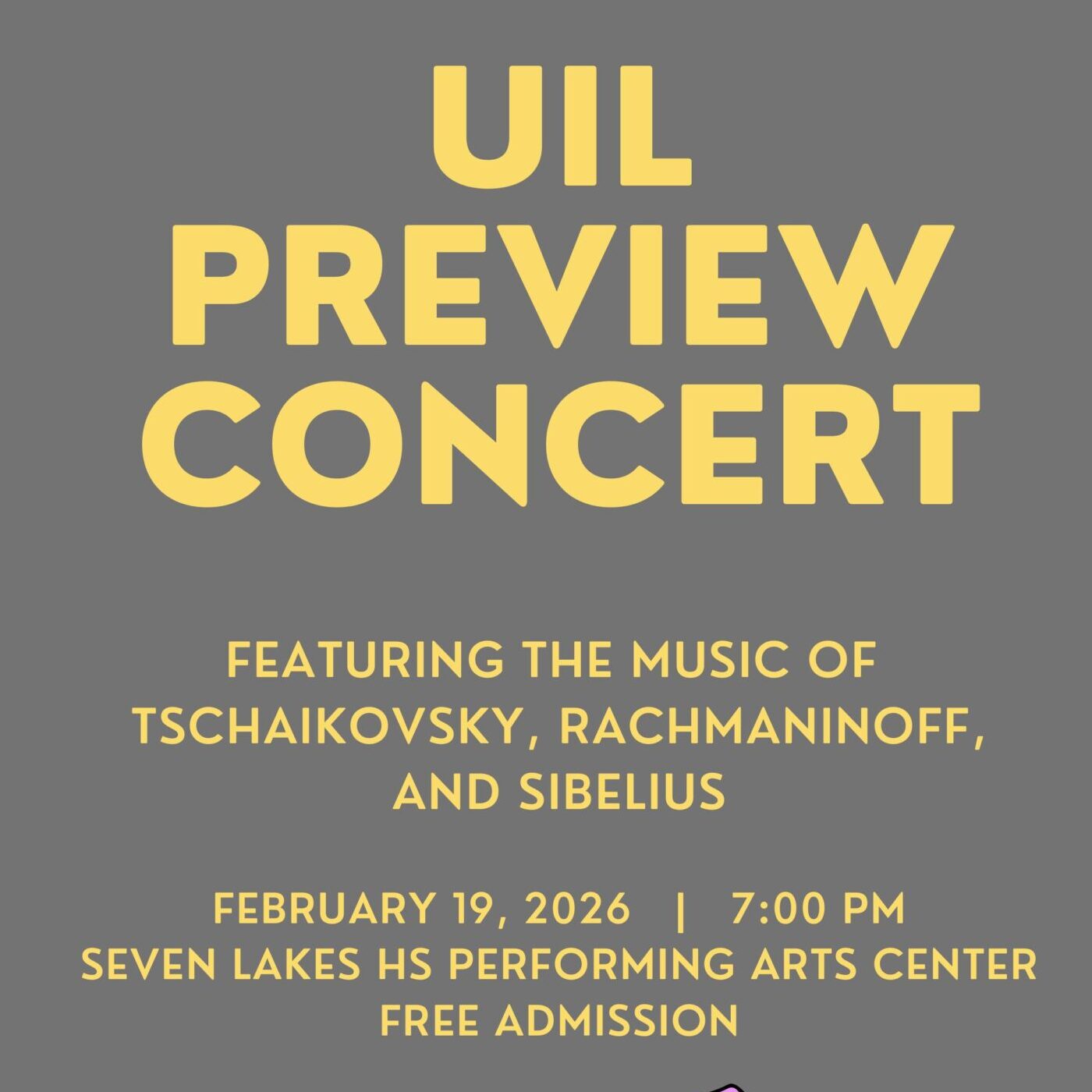
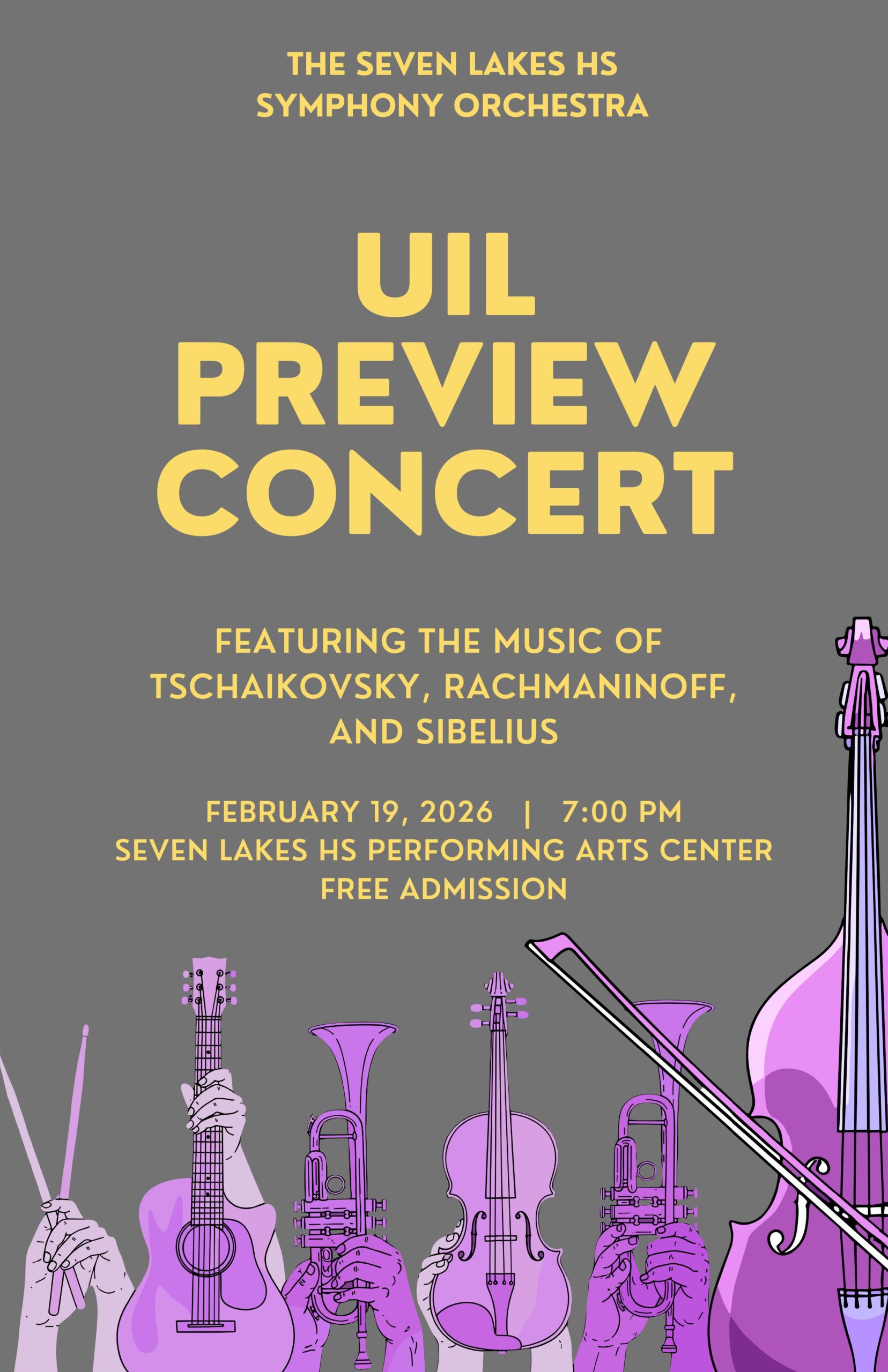
Our Symphony Orchestra students will perform again in preparation for their state assessment a week later. This UIL Preview Concert will feature music by Tchaikovsky, Rachmaninoff, and Sibelius. The concert is on Thursday, February 19th , starts at 7p and is free to the public.

Masterworks 2026: The Hope Within Us

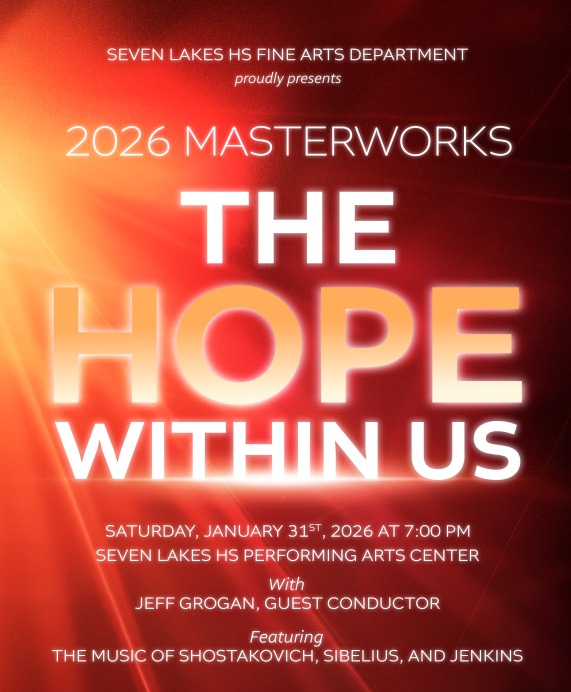
We are proud to present the biennial Masterworks ConcertThe Hope Within Us. This powerful evening brings together our band, choir, and orchestra students in a unified performance that explores resilience, courage, and the human capacity to rise above adversity.

Interwoven throughout the program are poetry readings that reflect on perseverance and hope, offering moments of reflection that deepen the emotional impact of the music. Together, these artistic voices create an immersive experience that speaks to the challenges of our time—and the strength found within community.

We are honored to welcome Jeffrey Grogan, newly appointed Director of Orchestral Activities at Baylor University, as our Guest Conductor for this special event. His artistry and leadership bring a compelling perspective to this inspiring program.
Learn more about Mr. Grogan here.

Seven Lakes HS Performing Arts Center
January 31, 2026 | 7:00p

$8 students | $15 adults
Tickets are available through Eventbrite.

Seven Lakes High School Symphony Orchestra Earns Second Place in The American Prize 2025

Seven Lakes High School is proud to share that the Seven Lakes High School Symphony Orchestra has been awarded Second Place in the 2025 American Prize in Orchestra Performance in the high school division.

The American Prize is a nationally recognized adjudication program that honors the finest achievements in the performing arts. Each year, ensembles from across the country submit recordings for blind evaluation by a panel of distinguished judges. Earning a Second Place award among such competitive national submissions is an exceptional accomplishment and speaks to the orchestra’s remarkable musical growth and artistry. The Symphony Orchestra is conducted by Desiree Overree, John Mays, and Sean Carlton.

The Symphony Orchestra’s recognition reflects:

  • Exceptional ensemble cohesion and musical expression
  • Strong leadership and direction from the orchestra staff
  • The dedication, discipline, and passion of every student involved

This award places the Seven Lakes High School Symphony Orchestra among the top high school orchestral programs in the United States and continues the school’s longstanding tradition of excellence.

We congratulate our Symphony Orchestra musicians on this outstanding national honor and thank them for representing Seven Lakes with such artistry and pride.

Congratulations to the Symphony Orchestra on this remarkable achievement!

Segue

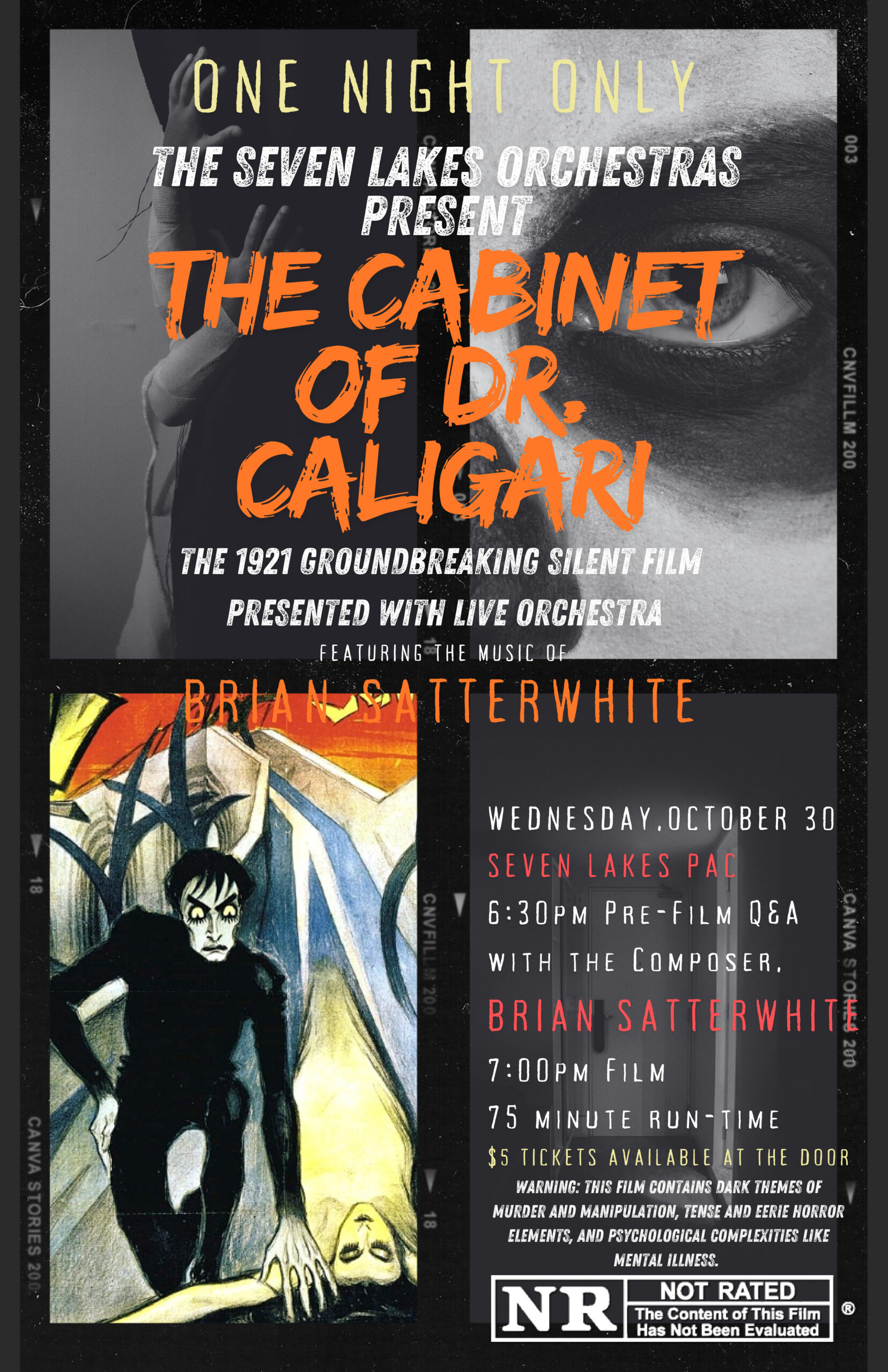
A Night of Chilling Cinema and Live Music – Experience “THE CABINET OF DR. CALIGARI”

Mark your calendars for a night where sound and silence come together in perfect harmony. On October 30, our exceptional high school orchestra will take the stage to accompany a live screening of the classic silent film “The Cabinet of Dr. Caligari,” with a chillingly evocative score by the film composer Brian Satterwhite. This will be no ordinary night at the movies. As the flickering, expressionist world of Dr. Caligari unfolds on the screen, our students will bring it to life with their musical interpretation—performing a score that dives deep into the eerie and mysterious heart of this iconic film. Imagine the tense, shifting moods of the film’s dark narrative perfectly mirrored by the haunting music played live by our very own young musicians. The contrast between the silent visuals and live orchestration will make for an immersive, unforgettable experience.

Additionally,  we are thrilled to welcome film composer Brian Satterwhite, the composer of the score for a Q&A prior to the film showing! Known for his scoring blending modern harmonies and classic styles, Satterwhite has crafted a spine-tingling soundscape that draws audiences deep into Dr. Caligari’s twisted world. Before the performance, there will be a special opportunity to hear him speak about the creative process behind composing for a silent film. Whether you’re a film buff, music lover, or proud parent, this event promises to captivate your senses and leave you talking long after the final note fades. Join us for an evening where the line between sound and image blurs and witness a high school orchestra deliver a live film score that will send chills down your spine. Come, be part of an experience that will transport you into the shadowy depths of a silent film classic, as our talented students bring it to life through music. Don’t miss out on this one-of-a-kind event!

📅 Date: October 30th 

🕒 Time: 6:30 Pre-Concert Q&A | 7:00p Film Showing 

📍 Location: Seven Lakes HS Performing Arts Center     

Ticket Info: $5 at door

Due to early voting, please enter the PAC through the 9th grade entrance, come down the main hallway, and enter in through the side door.

Celebrating Excellence: Two Orchestras Earn National Recognition with the Mark of Excellence Award

It is with immense pride and joy that we announce an incredible achievement for several outstanding orchestras, both of which have earned the prestigious Mark of Excellence Award from the Foundation for Music Education. Our 2024 Symphony Orchestra and Symphony Strings were awarded this crowning achievement! This national accolade recognizes the highest levels of performance in school music programs, and being selected is a true testament to the talent, dedication, and passion of our students. The Mark of Excellence is more than just a title—it’s a reflection of countless hours of practice, determination, and unwavering commitment to the art of music. These orchestras are not just ensembles; they are communities of students who have pushed themselves and each other to reach their fullest potential. Every rehearsal, every note played, and every challenging moment overcome has led to this shining moment of recognition.

What makes this achievement so inspiring is the collective effort that went into it. Our student musicians understand that excellence isn’t achieved overnight. It takes time, focus, and perseverance to refine their craft. Each individual player has contributed to the success of these orchestras through tireless practice and personal growth. From the softest string passage to the boldest brass fanfare, every sound was built on hours of dedication.

We are profoundly grateful to our directors, students, and the entire school community for their unwavering support in helping these young musicians reach such an exceptional level. Most of all, we are immensely proud of our students, whose effort, heart, and love for music have shone through every step of the way.

Lyrica Orchestra Earns Commended Winner Accolade through the Foundation of Music Education 

We are proud to announce that our third orchestra, Lyrica, also earned Commended Winner through the Foundation of Music Education. The Citation of Excellence project seeks to recognize and award outstanding achievement in performance by non-varsity high school and middle school bands and orchestras. A unique competitive environment is created which allows ensembles to compare their performance quality to other outstanding non-varsity ensembles. The top 25% of entrants are recognized as Citation Winners, with the second 25% named as Commended Winners.

Cadenza

Senior Gabby Ho performs at Carnegie Hall

This year, senior violist Gabby Ho performed at the prestigious Carnegie Hall. Watch as she shares her experience at the legendary concert venue!

Seven Tips on Acing Your College Auditions, From a Seven Lakes Orchestra Student

For students hoping to pursue a degree in music and continue their musical journey beyond high school, senior year comes a whole new category of stress inducers: auditions. From my personal experience with the process, I have written a simple set of guidelines on how to prepare for, practice for, and nail your auditions.

  1. Narrow down your options

The audition process is tough, so overloading yourself with too many will cause you unwanted stress and clutter in your schedule once the season rolls around. So instead of signing up for an audition at every school you’ve applied to, take some time to sit down with a calendar and research when each school’s audition dates are. You want to make sure that you don’t schedule an audition in Texas and another in New York on the same day. Pick a few schools (no more than 5) from your pool of colleges, and make sure that you won’t be spending excess time and energy auditioning at schools you aren’t actually interested in attending.

  1. Showcase your strengths

When you start deciding what literature to prepare, it’s not constructive to pull out the hardest piece of music ever written for your instrument and expect to get into your school of choice based on the fact that you played something flashy. Instead, look through your portfolio of repertoire you’ve already learned and find which pieces best suit you. From there, you can choose to learn something new based on those styles or re-learn something you have done really well on in the past. However, there’s nothing wrong with learning something new with the “go big or go home” mindset. Whatever your decision, make sure that you’ll blow the minds of whoever is listening with how well you know your music.

  1. Make practicing a priority

If you really are set on wanting to focus on music in college, it’s imperative to cut out anything that you know will hinder your ability to prepare for your auditions and make ample time available to practice. This one hits hard with me personally, as I had a difficult choice to make at the beginning of my senior year. I was already set on pursuing music in college, but was also very determined to succeed in my college-level calculus class, in which I was struggling. In the end, I chose to drop the class in favor of music, which not only removed the stress of my most intense class but also freed up an extra hour or two every day due to the absence of the homework and my ability to come home from school earlier every day. Ultimately, I had more time and energy to put into my auditions, and as a result did better than I had hoped to.

  1. Create audiences for yourself

One of the most daunting aspects of auditions is being required to play in front a group of professionals, most of whom you will not know at all (On a side note, it’s a good idea to take lessons with your potential professors during the year to get a feel for their teaching). To try and alleviate some of those nerves, it helps to periodically play your audition repertoire for a small audience comprised of some of your teachers, friends, or family members. Anyone who is willing to listen to you will do, especially if they have the knowledge to analyze your performance and give constructive comments and ideas. This will help you develop your confidence as a performer and hopefully break down some of your tension when you meet your panel.

  1. Ask Questions

When you finish your auditions, your panel will often wonder if you have any important, pressing questions that you want answered. Even if you have done lots of research, it’s nice to get information directly from the people you might be working with over the next stage of your education. Asking questions not only demonstrates to the panel your personal interest and commitment to your future, but might also reveal a vital piece of information that bumps that school higher or lower on your list of choices.

  1. Remember that it’s not just for them

Your auditions aren’t just for the professors to hear you, but also for you to get a feel for the school and make sure you fit in comfortably. Audition days usually have lots of opportunities to explore campuses, talk to students, and observe college as it naturally occurs. Of course, your first priority should be playing a successful audition, but you are encouraged to set aside time before you leave to take advantage of those opportunities and observe the personal side of your potential college rather than just the musical side.

  1. Make Connections

In the music community, it’s crucial to keep yourself involved in a network of people who can help you reach your goals. When you take your auditions, be prepared to introduce yourself to lots of people—they will likely have a lot to offer in the future, even if you don’t study with them. Everyone who you will meet on a college audition day can potentially help you reach your goals as a musician, so start creating your network now, and by the time you graduate, you’ll have a running start on everyone you’ll be competing against.

by Paul Zmick, Class of 2015

My Summer in Bolivia

In the Summer of 2014, I saw a side of the world that not many get to see. I traveled to my home country of Bolivia where I taught music at an orphanage that transformed my life. On my first day, I confidently walked with my violin past the worn-out wooden garage, unsure of what was about to happen. As a small nun approached me with a golden smile, there were girls pulling tree trunks on wheel barrows, feeding chickens, and watering gardens. We kindly greet each other as I introduced myself as the new music teacher at orphanage Maria Inmaculada in Santa Cruz, Bolivia. She guided me down a trail of large flat rocks leading into a small house, entered into a green room with a large picture of Virgin Mary in the back, and chatter filled the air as my 12 students prepared their chairs, music stands, violins, and violas.

news-boliva-2Within minutes, I had 24 eyes staring blankly at the stranger in front of them. I gave my introductory speech and started my first lesson. I counted about five that followed my instructions; they were all shy. As I tried to figure out what to do, I kept repeating: “if you sit up straight, you will sound great.” I snapped the beat, gave them their cue and they sounded weak as they played with no confidence. I knew I had to change that. In Spanish, I politely asked the first chair violinist, Zarita, for her instrument. I placed the violin in between my collar bone and left jaw and noticed she was missing the shoulder rest. When I realized that none of these girls had one, I felt a call to action.

Next class, I brought a sponge and 2 rubber bands for each of my 12 students. I passed them out, stood back and watched their reactions to their new shoulder rests. Gleaming smiles spread throughout the room when I placed the sponge on the back of a violin, secured it with 2 rubber bands and hooked them on the side curves of the instrument. They were astonished. They shyly thanked me and throughout the class there was a massive improvement in their sound. I had contributed in a very small way but it made a huge difference. They started following my directions closely. My initiative to bring the sponges helped them significantly as I prepared them for their upcoming performance. We were invited to play at a school’s inauguration. In formal attire, we took a minivan taxi and arrived promptly at the school. We were scheduled as the main performers. As we finished off our last song, “Viva Santa Cruz”, the claps and cheers roared “encore, encore, encore!” Skimming through their binders, they picked a song I had never seen before. Calmly, I took a deep breath, guiding the group into a smooth start. Although I had never played the song, I artfully lead the sound of my ensemble (thank you Mrs. Mathews). This was a performance we would cherish forever, if maybe for different reasons.

The last day I walked through those brown wooden doors, my grandfather was with me. He had been my biggest supporter for the past 12 years in this musical journey. I was leading the group alone today once again, as I had done most days. He had come to hear my students play and he sat there with absolute patience and respect with his usual million dollar smile. I was so thankful for having him there today. As we rehearsed for the last time, I decided to dedicate all the pieces to my grandpa. I counted the beat and gave the girls their cue as they filled my heart with the melodies we had rehearsed that summer. My grandpa cheered, clapped like a mad man, and made me feel proud of being a part of this. When we began to say our goodbyes, my students surprised me by singing a beautiful song. My grandpa captured the moment with his iPhone camera and I watched in awe. After the last note, Zarita approached me with a handmade kitchen towel. She said it was for my mother. My eyes welled with tears as my face felt small for my smile. Receiving this gift from these beautiful orphan girls was beyond special.

This experience highlighted to me how fortunate I am for my family, education, and cultural experiences. It also helped me continue to develop my leadership skills and serve as an example to my friends who questioned why I was doing this during my summer vacation. I now understand that I have a larger responsibility to continue my education so that I can give back to those who are less fortunate.

-Carlos Ribera, Violinist, Class of 2015

CODA

“A closing passage generally added to the end of a composition to provide a strong conclusion to the work, giving the piece a grander sense of finality”